

Hantavirus Outbreak Update
May 16th, 2026: Where we are now, what we actually know about transmission

I expect more Andes family hantavirus cases in people who were passengers on the MV Hondius in coming days. How many more is difficult to say. As of today there are 11 cases. In the United States 41 people potentially exposed are back on US soil and roughly half of them are staying in voluntary quarantine in Nebraska. Several have returned home to the 16 states shown on the map below.
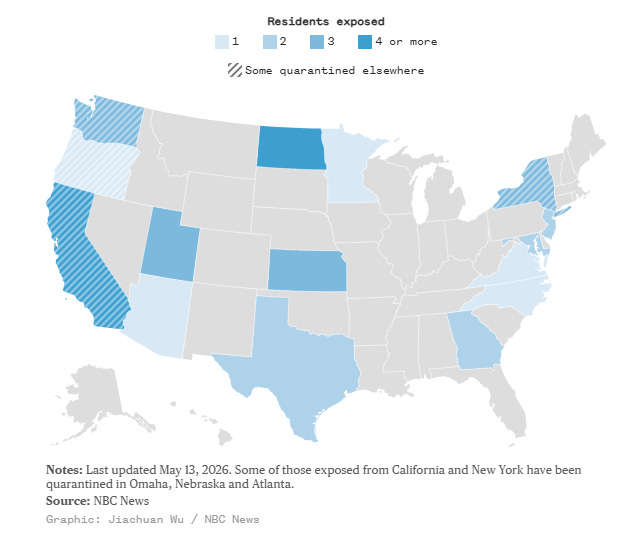
There’s a place between panic and turning a blind eye to major events that take the global stage like the most recent Andes Family Hantavirus outbreak and that’s where scientists step in. Right now the risk of a global outbreak is extremely low, I’m 4/10 concerned that we will see ‘on the ground’ transmission meaning cases that were not acquired on the cruise ship. Here I outline a few more research articles in detail that indicate why it’s a safe bet not to panic but that we SHOULD be aware that this is likely to happen more frequently in the future.
Even if more people from the cruise ship are infected, the risk this virus posses to the general public is still extremely low, and this is why I think so.
Research studies using of people likely to be exposed monitoring (prospective - study linked) and disease detectives trying to piece together what happened after an outbreak (retrospective - study linked) show that simple household contact and even exposure in a hospital setting to actively sick people is not enough to guarantee infection. This is good news, and why most people are cautioning that this outbreak will not likely cause a larger global outbreak. But outlier incidents with limited contact have also been reported. In short, we don’t have enough information to make high confidence predictions about how many more cases we will see. I’d be surprised (happily so), however, if it remains at the current total of 11 cases (3 deceased).
Even if there are a few more cases this does not necessarily mean we will see ‘on the ground’ transmission, but we’re not out of the woods just yet. Relentless international media and social media attention isn’t a bad thing - it puts strong political and social pressure on local and government authorities to prevent additional cases. It’s their job to contain these things, but the recent loss of appetite to fund research and disease prevention in many countries, including the United States, has put many people on edge. In short, the world is watching and we should be.
There Have Been Protocol Breaches But It’s Likely To Be OK
Despite best efforts and procedures accidents can and do happen but for this virus we have a bit more of a forgiving infection pattern. This week in a Dutch hospital there was a protocol breach in handling the blood and urine of a sick MV Hondius passenger. Patient urine from people who are actively symptomatic does contain enough of the virus to be infectious (no urine is not sterile). Now 12 of of the hospital staff members have been placed in quarantine for 6 weeks. Does this mean they will become sick? Not necessarily, in fact it’s unlikely.
A detail often left out by many people on social media posting about the now extremely popular New England Journal of Medicine article from 2020 detailing the spread of the largest outbreak of human-to-human spread ANDV is that there were several hospital employees exposed during that outbreak. In some cases no PPE was used. In one hospital no additional cases were seen despite exposure to actively sick people and only a small handful of cases resulted were seen in another hospital. Most people exposed to actively contagious patients failed to develop disease. Making it very unlikely a disease outbreak will occur from this variant of this virus.
In communicating risk, scientists like myself like to use the words probably and likely which can seem ‘wishy washy’ to the public which raises alarm bells, but that’s not the intent. One way to think of this outbreak is that several unlikely things from several failed quarantines (more opportunities for a virus to mutate the more people it infects) to virus mutation in a way we haven’t seen before would have to happen. So maybe in one of 10,000 or 100,000 timelines that might occur with an outbreak like this.
The smart bet is on this outbreak not being an issue while knowing that if it were to become one we’d see it coming, and some day it is coming and public awareness of this is good.
A Matter of When Not If
Andes family hantavirus infections doubled in the region from 2025-2026 and at some point in the future of humanity - if we keep seeing rising local infections - this virus will eventual adapt to human infection in a way that spreads it more efficiently. Either next week or 500 years from now it’s hard to say, but the longer we see increased infection rates the more likely it becomes.
Hantaviruses are not the only ones ‘out there’ that, in the future, could cause a major outbreak. And just like every medical student at one point starts to feel like a hypochondriac, every scientists I know who has studied the vast diversity of viruses has gone through a brief moment of panic. On the other side of that panic is a deep awareness of how tenuous life actually is and how deeply important continued research in these areas is for continued survival.
If any good was to come of this outbreak it is that public awareness translates into public appetite for ensuring we have programs that protect us and future generations from deadly viruses (and there are plenty out there) that may make the leap to spread human to human.
Stay tuned for my next post on the unique immunology behind why Hantaviruses are so deadly and what this may mean for people who recover from them.