

The Next Two Weeks Are Critical: Global Race to Stop an Outbreak of The Hantavirus
What can happen and where we are now

Introduction
Every single one of us carries scar tissue from experiencing a recent global pandemic.
We’ve lost loved ones, worked frontlines, felt both abandoned and fatigued by attempting to keep up with messaging that evolved real-time as the scientific understanding of the SARS-CoV-2 virus changed, and the virus itself mutated. Some variants gaining higher transmission capabilities and more deadly symptoms (Delta) before the dominant variant mutated again into a higher transmission rate version (Omicron) which was on an individual level less deadly. But, Omicron, I need to remind everyone who irresponsibly reported “don’t worry it’s less deadly”, on a population level injured and killed more people because of it’s enhanced spreading capabilities.
Many still feel left behind, their debilitating symptoms unaddressed by research with little appetite for the current administration to fund NIH investigation into Long COVID. Others left untouched by the deadly virus or still in denial that viruses exist are rallying around the idea that this zoonotic spill over event, a hantavirus outbreak is nothing more than “another Plandemic”.
Most are asking me: Here we go again?
Not quite.
We have a window of time between initial exposure(s) and when symptoms may start to show up and what is done over the next two (up to four) weeks has the power to change the direction of this outbreak.
Where we are now
The next two weeks are absolutely critical for controlling this zoonotic spillover event. Zoonotic spill over is when a virus typically found in an animal population infects humans. Because we understand the hantavirus well, we know exactly how to stop the spread of it right now. This game is ours to loose but the question remains will egos, human error, and human nature unleash the spread of a new virus across multiple continents? It could, but if good science prevails it will not.
What Is Different About Hantaviruses
Large Family of Ancient Viruses That Has Co-evolved With Rodents: Hantaviruses are a large family of over 50 viral strains (and counting) which have co-evolved with rodents over an estimated 80-100 million years. These are ancient viruses. Their rodent hosts (and bats occasionally) can have very high viral loads but show no symptoms at all. Rodent immune systems make antibodies against the virus but do not control it. Different groups of rodents have different endemic hantavirus strains in their populations (roughly location specific to their coevolved rodent hosts). In contrast, SARS-CoV-2 was a completely novel virus at the time that researchers and medical professionals scrambled to learn about ‘on the fly’. The origin point is not fully understood to this day, though regionally there are several endemic coronaviruses in bat and pangolin populations. In general, we know much more about hantaviruses.
10,000 to 100,000s Of Cases Annually: Hantaviruses infect anywhere from 30,000 to 150,000-200,000 people annually. Most cases are are from hantaviruses that cause hemorrhagic fever with renal syndrome (HFRS) which are endemic to Asia and parts of Europe. About 200 cases of hantavirus pulmonary syndrome (HPS) occur across the North and South America annually. The exact number of cases is hard to pin down due to underreporting. Therefore, unlike SARS-CoV-2 people understand the course of infection for many strains of this virus and what prevention and care looks like - even though we currently have limited to no specific pharmaceutical options.
High Mortality, Low Rate of Spread: Hantaviruses are more deadly than SARS-CoV-2, but they have a lower rate of spread. First, the vast majority of hantavirus species do not spread between people. Unfortunately, the Andes species (ANDV) of hantavirus, which is the cause of the current outbreak does spread between people. The largest known outbreak, the Epuyén outbreak (named for the small town in the Andes mountains where it occurred) led to 34 cases and 11 deaths (32% case-fatality rate). In general, hantaviruses have a case fatality rate of 21-60% depending on the outbreak and virus type. The Epuyén outbreak was contained via simple quarantine measures, but not before the virus displayed a reproduction rate or Ro (how many people are infected by one sick person) as high as 2. For comparison, seasonal influenza typically has an Ro of 1.2 to 1.4. However, spread in the Epuyén outbreak was fueled by family events in enclosed spaces for extended periods of time with actively symptomatic relatives. Furthermore, the contact tracing within these events is noted by the authors of the paper as being difficult and potentially erroneous.
Currently on social media and from some commentators the ‘passing briefly in the hallway during a birthday party’ is being touted as an example of airborne spread. This would be close enough for an effusive greeting to spread a virus by droplet and notably it is common in many areas of the Andes to greet people by a kiss on the cheek - though we do not know if this occurred. SARS-CoV-2 started out at a slightly higher Ro between people but also rapidly mutated to a higher Ro. Both are RNA viruses which have high rates of mutation and ANDV can, like any virus adapt itself to it’s host. Therefore, I’d like to emphasize that although I am not overly concerned: Right now we’re at at critical moment where containment can reduce chances of additional spread and human adaptation.
Limited Information on Behavior of ANDV in Human Populations:
Much like the earliest days of the SARS-CoV-2 pandemic we have limited information on spreading dynamics of the now named strain ANDV/Switzerland/Hu-3337/2026 ("Hu-3337") in human populations. The Epuyén outbreak being the largest human to human outbreak to date. Furthermore, because the Andes family of hantaviruses are difficult to culture in vitro, scientists have had limited ability to study their behavior relative to other viruses. That said, I expect the Ro (reproduction rate) on the cruise ship to be artificially high relative to ‘in the wild’ spread. This is because of close quarters typically seen on a ship, and opportunities for prolonged exposure prior to understanding the seriousness of the viral illness.
What we know now is that this virus typically spread via droplet transmission between people. What we know about most viruses is that there is a period of pre-symptomatic spread. Pre-symptomatic spread is typically higher than asymptomatic spread (career never develops disease). We know that hantavirus is killed by a 10% bleach solution and most household cleaners, sunlight, heat, and a few days outside of the body. Hantaviruses can live longer in cooler, higher humidity environments remaining infectious for up to 5-15 days in certain conditions. We know that rodents are asymptomatic carriers, which begs the question in my mind as a scientist if the virus could adapt to people in the same way. Perhaps if we decide to begin funding scientific research again, a survey of local populations for antibodies and any evidence circulating virus would be of interest.
ANDV Hantavirus Infection Events Have Increased Recently
Since June of 2025 there has been a “surge” in ANDV family hantavirus cases in the with 101 cases reported in the last year, roughly double the historical average in the area. While Argentine officials have increase surveillance for ANDV after the Epuyén outbreak and local hospitals have increased testing, other factors including human encroachment on rodent habitat and climate changes increasing rodent spread or migration into new areas has also been indicated as a factor in increases in local case rates.
In summary, this virus is concerning but unlike SARS-CoV-2 we have ways to get ahead of it, if our leadership makes the right decisions. Admittedly, I am suffering from my own memories of thinking how simple that should have been with SARS-CoV-2, because we have the playbook - it’s our game to lose.
What’s The Worst That Could Happen?
Best-case Scenario: Global Leadership Takes This Seriously
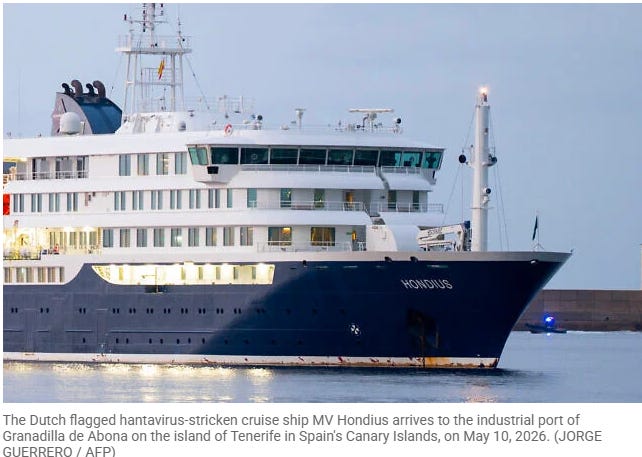
Ideally, professional grade quarantine and testing of every passenger of the MV Hondius until the end of the viral incubation period would ensure we have stopped the possibility of continued human to human spread. I feel deeply for the people who took a once in a lifetime vacation that has turned into a nightmare. But remaining in quarantine ensures ready access to testing and early indication of positivity prior to the development of symptoms. This can lead to rapid access to medical care and likely a higher rate of survival if someone falls sick. It is the choice I personally would make. I expect given the environment of the cruise ship that we will continue to see additional positive cases for up to four more weeks. Therefore quarantine is a potential win-win for protecting other people and getting assistance quickly in a deeply unfortunate situation. I am concerned, however, about the US leadership’s active reticence to discuss quarantine and determination that ‘at home self-quarantine’ should be an option. Despite having very little information about the spreading dynamics of this virus, the vast majority of viruses have a phase of pre-symptomatic spread making it likely that people at home will unwittingly spread this virus to family members or out in their community. Therefore, I think that given current information on the approach in the United States, the moderate-case scenario is a likely one.
Moderate-case Scenario: Risky On-The-Ground Spread
If we do not quarantine passengers that are currently ‘feeling fine’ there is potential that we will see on-the-ground transmission of this virus here in the United States. We may get lucky and this may not happen at all, but self-quarantine measures increase the likelihood of on-the-ground spread. Globally, without quarantine I expect a few more cases (at the global level) to spread on-the-ground in those countries. If person to person transmission occurs here in the United States, local and state department intervention will be important. The CDC may be able to assist but due to the defunding and dismantling of many of their programs and little to no leadership left, their scientists will be fighting with both hands tied behind their backs. Therefore, because of the significant leadership gaps in HHS and CDC, it will be up to local and state health departments to stay on top of these cases and mitigate spread. These agencies have different levels of effectiveness across our country so if those fail significantly in one or two areas we are likely to see a what I consider a poor outcome.
Poor-outcome Scenario: Failure Of Complete Containment
If containment of person-to-person spread fails at the state and local level I expect this to look a bit like the MPOX outbreak where there is spread within specific pockets of people who have come into close contact with each other. At this point I would expect most people to be taking this seriously. A ~40% case fatality rate may in fact make inroads into virus denying communities re: deciding to pay attention, but it’s difficult to predict what will convince people to take their personal health seriously. What concerns me, however, is that the MPOX outbreak was trending poorly and on track for wider spread until CDC and FDA scientists determined they could expand vaccine coverage by giving the dose at 1/5th the amount and subcutaneously (under the skin) rather than intramuscularly (jab in the thigh or arm). We have no vaccine or specific treatment for hantaviruses. In this scenario I believe cases would continue to ‘pop up’ until we developed a vaccine or other intervention to completely eliminate spread. To be clear, I still think this is a relatively low probability scenario.
Absolute Worst-case: “Stuff Of Nightmares” Scenario
A friend of mine occasionally likes to say that worry is a misuse of imagination. But sometimes staring into the abyss is just part of human nature so let’s take it there - knowing full well that this is currently an highly unlikely set of scenarios.
If this virus mutates during any of the above scenarios to adapt better to human to human spread or improves it’s transmission capabilities such that it is airborne, then and only then, do we have a COIVD-19-plus scenario on our hands. In this case I would expect the case fatality rate to drop due to the sheer number of infections, but for there to still be significant loss of life on the order of 2 to10-fold of what occurred at the peak of the COVID-19 pandemic. Air travel lockdowns would be the intelligent choice for global leaders to make, isolating any country where the mutation is found immediately. But that would have also slowed SARS-CoV-2 and it did not occur. At this point the race for a vaccine and anti-viral drugs would be back on, but I am not sure the United States has the political will or capacity to lead it, over 10,000 STEM PhDs have left the federal government since early 2025 and many have left the country. People who continue to ignore the precautions of scientists in a situation like this would be at very high risk of illness or death. Finally, if like SARS-CoV-2 the human-adapted hantavirus becomes incredibly widespread, local rodent populations may become infected and it will become an endemic virus in their population and an ever-present human threat.
It is human nature to catastrophize events like this. It’s a mechanism for preparation and self-protection, but I do believe this is an extremely low probability scenario that we’re more likely to see on a movie screen than our nightly news.
Summary
Right now we are in a moment of ‘wait and see’ and shifting probabilities. The direction this event takes depends on how the people closest to the situation react and how our leadership chooses to lead (or not). In some cases how the people who were passengers of the MV Hondius choose to react can change the current trajectory. If they are given a choice to quarantine, I hope they choose to do so. My heart goes out to them, their families, and everyone directly impacted by this traumatic event.
There are thousands of viruses that are deadly and knocking at the door of global transmission - causing brief outbreaks in far-flung places - testing and re-testing humans as a potential new host species. This event is a reminder to call our representation and insist that we have competent leadership at organizations like the CDC (80% of top positions are vacant, and our interim head is an economist, not a scientist) and HHS. Good leadership is critical to meet the global challenges of virus and disease control before deadly viruses show up in our communities, our homes.